
Every day, more than 100,000 new songs get released on Spotify. If you just focus on good music, you’ll get lost in the crowd. In the past, the path to success was almost exclusively through record labels, radio stations and live events. Today, social media gives you a direct link to your audience. You decide for yourself when, how and what you want to publish.
But how do you use social media to make a name for yourself as an artist and find success with your own music? What sort of content really works? Whether you’re a musician, songwriter, producer or part of a band: in this article, you’ll find out how to use social media to gain more visibility and reach.
Key points at a glance
- Fans follow artists to get to know the person behind the songs, not just for the music.
- Short-form videos such as Reels, TikToks and Shorts are the best way to reach new fans outside your own community.
- Successful content offers added value through entertainment, relatability, exclusivity or knowledge.
- A strong hook in the first few seconds determines whether users stick to your content or scroll on.
- Consistency and authenticity are more important than perfection when it comes to content, and are rewarded by the algorithm.
- It’s not the number of followers, but the skip rate, watch time and engagement that show whether content is really working.
Why is social media so important for musicians?
Social media is no longer just an “add-on” for musicians, but the most important tool for building a career independently. With the right content on platforms such as Instagram, TikTok or YouTube, you can boost your reach and visibility and build a loyal fanbase. But many artists make a common mistake: they only post about new releases, saying something like, “My new song is out – stream it!”. But it’s a misconception to think that the whole world is waiting for your next track. People follow artists and bands because they want to know the person behind the music, be part of their journey and feel entertained. They don’t buy tracks from strangers; instead, they support artists to whom they feel a connection.
Which platforms and formats are best for musicians?
The most important social media platforms for musicians and producers are Instagram, TikTok and YouTube. Depending on your target audience, Facebook or Snapchat may also be worth considering. You don’t need to be active on every platform. The key is to identify where your target audience spends their time and which platform offers you the best balance of effort and return for your specific goal.
When it comes to formats, short-form videos such as Instagram Reels, TikToks, YouTube Shorts or Facebook Reels are best for reaching new potential fans. In our experience, high-performing Reels reach 70 to 80% of people who don’t yet follow you. Stories, images and carousels, on the other hand, usually reach existing followers. They’re ideal for building a stronger relationship with your community, for example through polls or glimpses into your daily life.
What defines good social media content for musicians?
Let’s be clear: there is no guarantee that content will go viral. Algorithms, trends and human behaviour are constantly changing and are largely unpredictable.
But: just like with music, you can greatly increase your chances by taking a planned and thoughtful approach rather than simply waiting for that one random hit. Successful, viral content is rarely down to luck but the result of a strategy, consistency and analysis.
For the best results with your content, there are 3 criteria to keep in mind:
1. Relevance and added value
With every post, ask yourself: why would anyone want to watch this? People mainly use social media to relax, have a laugh or escape from everyday life. So your content should be fun and emotionally engaging. That means it should meet at least one of these needs:
Entertainment/humour: Does your content make people laugh and can it amaze or inspire them? For example, show the funny and chaotic sides of life as a musician or in a band, and don’t take yourself too seriously.
Identification/affiliation: Engage with your community on a personal level, ask questions and show interest in their opinions. You can do this, for example, by running polls in your Stories such as “Which song cover do you prefer?” or “What do you think of this sound?”. Stay approachable, share your thoughts and talk about personal things. For example, as a songwriter or producer, you could tell the emotional story behind a song or speak openly about self-doubt, writer’s block and fails.
Exclusivity: The feeling of being an insider creates an extremely strong bond with fans. People love being part of an inner circle and seeing things that normal listeners don’t get to see. This could be previews and unreleased material, or an exclusive look behind the scenes. Questions such as “How did this voice memo turn into a finished song?” or “How did I turn this everyday sound into a beat?” also work well.
Knowledge: Every now and then, you can give other musicians and music nerds in your community some tips on songwriting, producing or mixing. Or showcase your gear and share details about your workflow – for example, “This is how I achieved this guitar sound” or “This is my vocal chain”. This is a strong format, particularly for music producers and audio engineers. Such content demonstrates your expertise in your field.
2. The first 3 seconds: the perfect ‘hook’
The hook is whatever grabs the viewer’s attention in the first few seconds, making it the most important benchmark in social media marketing. Whether it’s a Reel, a TikTok or a YouTube Short: you’re competing with countless content creators for the same audience and have very little time to win them over. This is also known as the 3-second rule. The opening decides whether users keep listening or scroll on. And whether the algorithm classifies your video as interesting and continues to feature it.

A great hook can work in different ways: visually through what you see, for example an unusual perspective or a surprising scene.
Through text by way of captions,, such as a headline that grabs your attention.
And audibly through what you hear, such as a distinctive sound or a powerful opening line.
The best openings use psychological triggers such as promises, secrets or provocations. If you start your video with ‘Hello, I’m XY and my new song is now on Spotify …’, most users will simply skip your content.
Here are a few examples for powerful hooks:
- “This is a voice memo from 3 am. It turned into this …”
- “My producer said the bridge was sounding boring. He was right.”
- “Only 200 streams on Spotify?! Here’s why it was still my best production”
- “The best bit of this song was a mistake made during recording.”
- “I can’t play the piano at all, but I still produced this song.”
- “This music video cost me €3,000 …”
- “How this song was rejected 10 times before it was finally accepted”
- “Six months on this song – was it worth it?”
- “This song project nearly ruined me financially!”
- “If you follow this tip, you’ll never have an unfinished project again”
Once you’ve managed to grab people’s attention, you need to keep them hooked. And that’s not just down to what you say, but also how you structure your video.
Skip the long introduction and jump straight into the most exciting part. Add quick cuts right from the start and make sure there are plenty of scene changes. So don’t just show yourself in front of the camera the whole time – bring some variety to the shot.
Reverse storytelling is really effective: you tell the story in reverse, showing the outcome first. This builds a sense of curiosity, and people will watch right to the end to find out how you got there. This also helps boosting your watch time.
So-called pattern interrupts can also help you stand out from the crowd. This refers to deliberately breaking with habits and expectations, for example through an unexpected scene, a false start or an unusual camera angle.
A provocative question or statement can also spark curiosity. But use provocations with care, because if you overdo it, your credibility will suffer.
3. Consistency and analysis
The algorithm rewards consistency. You need a regular posting schedule. Ideally, you should aim for 3 to 5 posts a week, though this varies depending on the platform. For the best results, TikTok officially even recommends posting between 1 and 4 times a day.
Remember: consistency beats perfection. The algorithm needs enough data to show your posts to the right people. One “perfect” video every two weeks isn’t enough.
Recurring content formats help you find topics on a regular basis. But make sure this doesn’t lead to dull repetition. Also, maintain a consistent brand across all your profiles – from Instagram to TikTok to YouTube – so that people recognise you straight away.
After posting comes the most important step: analysis. Find out more in the section “How do you know if your social media content is working?“
8 content ideas for musicians, bands and producers
Behind the scenes
Show your fans what goes on behind the scenes – whether you’re recording or jamming in the studio, doing a soundcheck or getting ready backstage. It’s precisely these unfiltered glimpses that let you be authentic and bring you closer to your fans.
How I made
Take your community with you from the initial idea right through the creation of a song – for example, with a voice memo sketch that later becomes a finished track. Fans love following the process and getting involved. Let them actively participate by sharing polls on sounds, melodies, lyrics or song titles.
Rankings
Create rankings related to music, such as your favourite albums, the best plugins or your own songs. As most people want to stick with it until you reveal your number one, this format can lead to high watch time and encourages discussion in the comments.
Examples: ‘My top 5 guitar riffs of all time’, ‘I’m ranking my own songs’, ‘The 3 plugins I can’t mix without’
Trendjacking/memejacking
Pick up on the latest sounds, memes or challenges and combine them with your music. This increases your chances of being featured by the algorithm.
Style swaps/what if
Show, in short clips, how your song would sound in a different genre or in the style of a well-known producer or artist. It will keep viewers engaged right until the end.
Examples: “This is what my song would sound like as a rock, lo-fi or techno version”, “What if Artist XY had produced my song?”
Reactions & song analyses
React to current hits in an entertaining way, whether they’re viral songs or tracks your fans love, whilst explaining what makes the song stand out musically or in terms of production. By referencing well-known tracks, you’ll reach people who are specifically searching for these songs or following these artists, whilst showcasing your expertise.
Examples: ‘Why this chorus works so well’, ‘Producer reacts to the charts’, ‘I analyse your songs’
Note: When creating this type of content, be cautious of copyright laws and only play short snippets of other people’s songs, whilst ensuring your own analysis remains clearly the main focus.
Giveaways
Competitions and giveaways are a widely used way to quickly increase your reach. By giving away prizes that are especially interesting for dedicated fans – such as signed merchandise, concert tickets or a meet-and-greet – you can largely avoid building up a large number of inactive followers who are only interested in winning.
Examples: “Prize draw: 2 tickets for our release concert”, “Comment on your favourite song and win a signed vinyl”, “Win a meet-and-greet after our show”
Collabs & duets
Make videos together with other musicians or creators; get close artists to remix your song, or have influencers feature it in their videos. This is particularly easy to do with the ‘Duet’ function (called ‘Remix’ on Instagram), where your video plays in a split-screen right next to another creator’s original video.
This way, with a single post, you can reach your collaboration partner’s community and gain new listeners who would otherwise never have discovered you.
Examples: “Duet with a fan who covered my song”, “I had artist XY remix my song”, “Dancer XY choreographed our new track”
Examples of successful social media content
How do you know if your social media content is working?
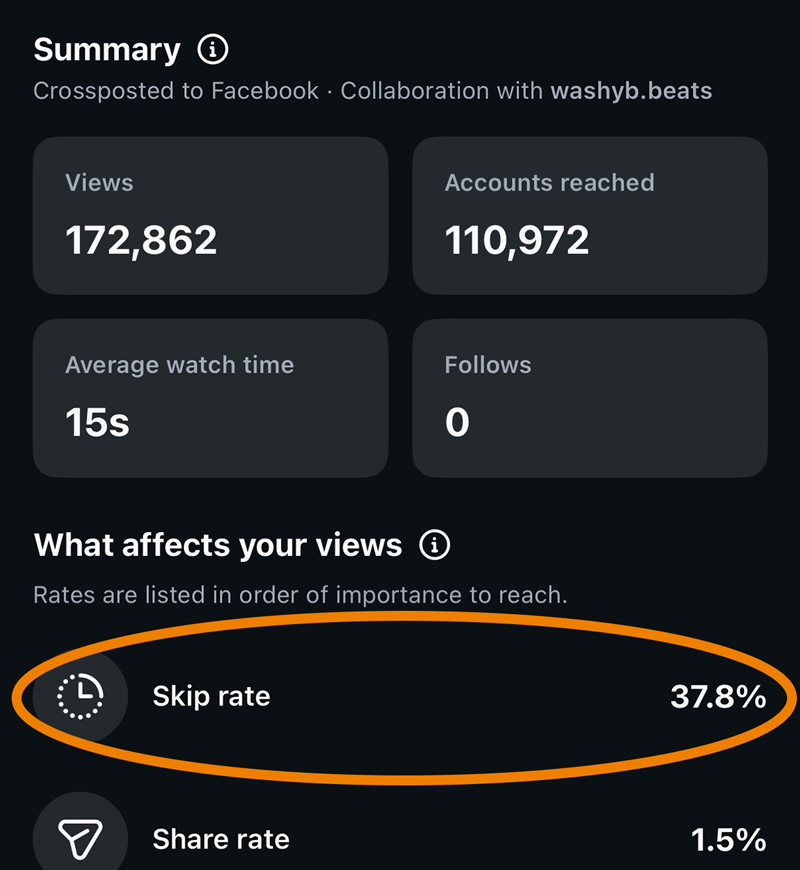
Having lots of followers looks good. However, watch time and engagement – i.e. likes, comments, saves and shares – are more valuable. For your hook, the skip rate is particularly important. It indicates how many users scroll past your video within the first 3 seconds. If it’s over 50%, you should work on your opening.
If you want to know how long users actually stay with your video during their first playthrough, the average watch time will help you. The higher, the better – although this naturally also depends on the length of your video.
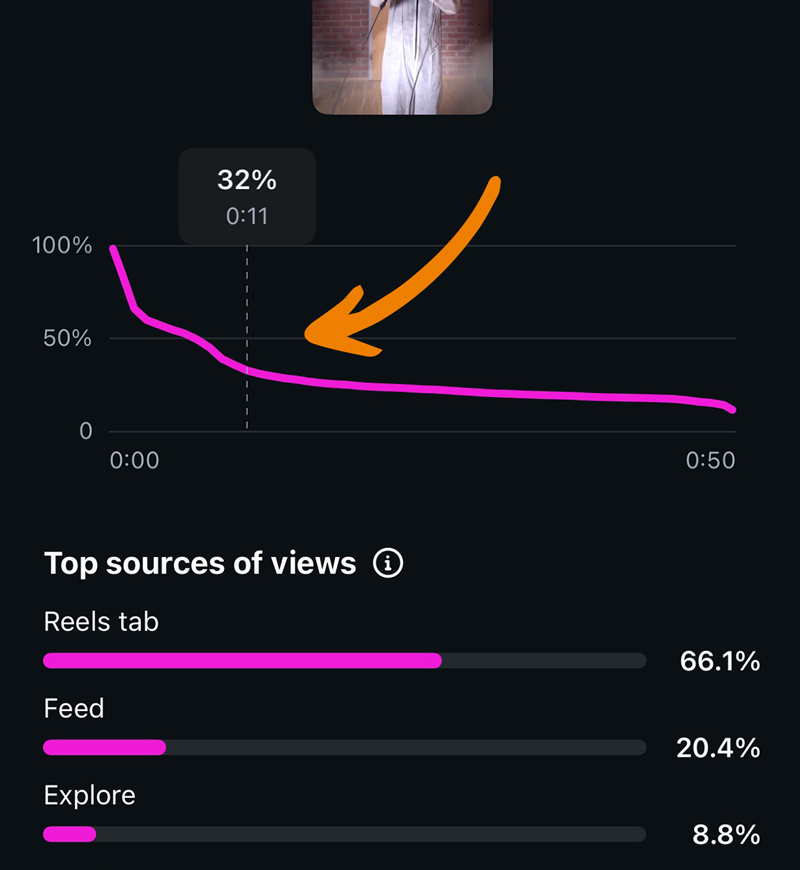
You can see exactly where in your content your viewers drop off in the line chart for the retention rate: it shows you the percentage of viewers still watching at each individual point in the video. If they stick with it until the end, the algorithm classifies your content as valuable and pushes it further.
The percentage breakdown of your views between followers and non-followers (‘virality factor’) is also interesting. If the ratio for a post shifts significantly towards non-followers, that’s a good sign: your content is then spreading beyond your own community and reaching people who didn’t know you or your music at all before.
So, after every post, ask yourself these questions: Was the hook good enough? Which posts have the longest average watch time? At what point in the video did most users drop off? And which topics generate the most engagement? You can find all these metrics in the Insights sections of Instagram, TikTok, YouTube and other platforms.
Conclusion
Successful social media content doesn’t happen by accident. Don’t treat Instagram, TikTok and YouTube as billboards, but as social networks. Use your content to add value through entertainment, relatability, exclusivity and knowledge. Make sure the first three seconds of your Reels and Shorts grab attention with a strong hook. Publish content regularly and figure out what works well and what doesn’t. Also, keep your social media knowledge up to date: be curious, follow the latest trends and draw inspiration from other successful artists. And above all: stay approachable to your community, collaborate with other artists and grow together.
Successful social media content increases your reach and builds a loyal fanbase. However, if you want to make a name for yourself as an artist or build your own brand, your music should also sound professional. This is where our online course in sound engineering AUDIO DIPLOMA comes in. The course teaches you everything you need to know for professional recording, mixing and mastering in a practical way – with real studio productions and individual feedback.

