
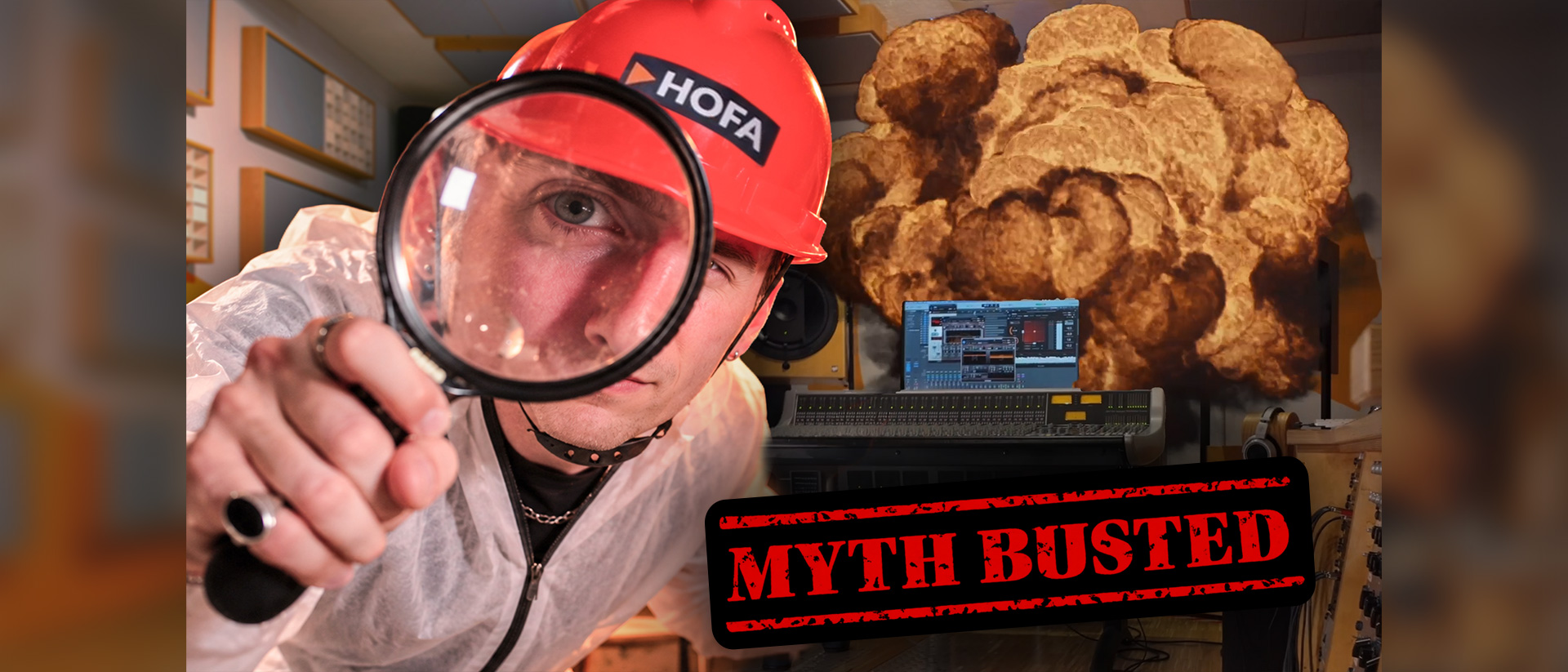
Myths in audio engineering can be surprisingly persistent.
In this short-form video series, HOFA-College tutor Tim Müller takes a closer look at some of the most interesting audio engineering myths.
Myth 1: Every DAW sounds different
It is surprising how many people still believe the myth that different DAWs inherently sound different. However, modern DAWs use largely standardized mathematical processing, typically with 32- or 64-bit floating-point calculations. With identical audio files and settings, the result should therefore be virtually identical.
Differences can still occur, for example due to different pan laws, resampling algorithms, automation behavior, default settings or the stock plug-ins being used. So what is often perceived as a DAW’s own “sound” is usually more a result of its settings and workflow than of the audio engine itself.
Myth 2: EQ first, then compression
The order of EQ and compression is not fixed – it depends on the result you want to achieve. An EQ before the compressor changes the signal the compressor reacts to, so strong boosts in certain frequency ranges can also affect how the compression behaves.
That’s why it often makes sense to remove problematic frequencies first with a corrective EQ, then apply compression, and shape the tone afterwards with another EQ. Ultimately, the best order depends on the source material and the sound you’re aiming for.
Myth 3: Higher sample rate = better sound
A higher sample rate such as 96 kHz does not automatically mean that a recording will sound noticeably better. According to the Nyquist-Shannon theorem, a sample rate of 44.1 kHz can already reproduce frequencies up to just over 22 kHz, covering the range relevant to human hearing.
Higher sample rates can offer technical advantages in certain processing scenarios, such as distortion, pitch shifting or complex signal processing, and can help reduce aliasing. At the same time, they significantly increase file size, storage requirements and CPU load.
For playback alone, 96 kHz is therefore not inherently “better”. What matters far more are the quality of the recording, the converters, the processing and the audio material itself.
Myth 4: Acoustic foam improves your room sound
Acoustic foam is often used as a simple solution for problematic room acoustics, but it mainly affects higher frequencies. Because the material is usually relatively thin, lower frequencies can pass through almost unaffected and continue to reflect, while mainly the highs and upper mids are absorbed.
This can make a room seem less reverberant, but it does not automatically result in balanced acoustics. For more even control across the frequency spectrum, thicker broadband absorbers and bass traps are much more effective.
So it’s not just the material itself that matters, but especially its thickness, placement and the frequency range that actually needs to be treated.
Myth 5: Never use small-diaphragm microphones for vocals!
The idea that large-diaphragm microphones inherently sound more professional or better than small-diaphragm microphones is not accurate. Large-diaphragm microphones often offer higher sensitivity and lower self-noise, which is why they are especially popular for vocal and speech recordings.
Small-diaphragm microphones, on the other hand, usually respond very precisely to fast transients and often provide a more consistent polar pattern across a wider frequency range.
So diaphragm size alone does not determine the quality of a microphone. Far more important are its design, the desired sound character and the specific recording situation.
Myth 6: You need an atmos setup for 3D audio
3D audio also works over headphones and does not necessarily require an elaborate multichannel speaker setup. What matters is how our hearing perceives sound coming from different directions. Using so-called Head-Related Transfer Functions, or HRTFs, the frequency-dependent changes caused by the head, outer ears and upper body can be reproduced. This allows the brain to interpret spatial positions even with just two headphone channels. Techniques such as binaural rendering use exactly this effect to make sound sources appear in front of, behind, above or beside the listener. The quality of the spatial impression depends greatly on the HRTF used and the listener’s individual anatomy.
Myth 7: Kick & Bass MUST be separated for clean low end
Kick and bass do not necessarily have to occupy completely separate frequency ranges. While both instruments can mask each other in the low end, EQ cuts alone are not always the most effective way to solve this issue. What matters more is the interaction between level, timing, tonal character, and dynamics.
Techniques such as sidechain compression can also help by temporarily creating space for each signal. Many successful productions also demonstrate that kick and bass can share similar frequency ranges. The goal, therefore, is not strict frequency separation, but to make sure that both elements remain clear, controlled, and well-defined within the overall mix.
Myth 8: Dithering is ALWAYS necessary
Dithering does not inherently improve sound quality; it is primarily used when reducing bit depth. For example, when converting a 24-bit signal to 16 bit, quantization introduces small distortions and rounding errors. Dither adds a very low level of noise, which makes these errors less correlated with the signal and therefore less noticeable.
During production, or when the bit depth remains unchanged, dithering does not provide any real benefit. It is most useful at the very end of the signal chain, when the final file is exported at a lower bit depth.
You want to learn all about audio engineering and music production?
The AUDIO DIPLOMA online course from HOFA-College will give you the complete knowledge and practical experience for excellent sound.

