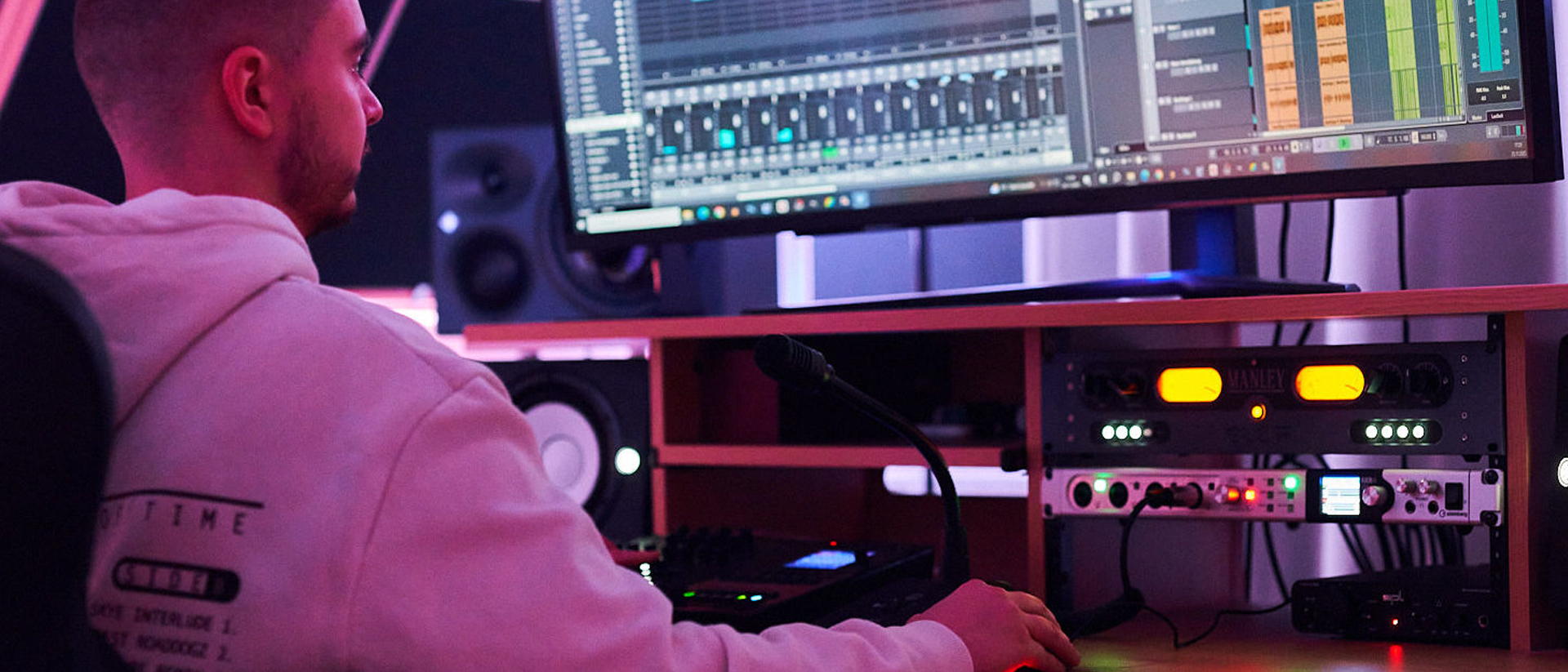
With the AUDIO DIPLOMA online course, Raik Menzel has turned his dream into reality: Today, he runs his own recording studio and makes a living from producing music. In this interview, he shares how he achieved his goals.
How did you first get into music production?
I originally come from a hip-hop background. Like many others, I started out with a simple €80 microphone in my bedroom.
Over time, I realized that my strengths weren’t necessarily in making music as an artist myself, but rather in working with other artists and producing their music.
I was already looking for ways to develop my skills further when I came across HOFA-College and decided to enroll in the AUDIO DIPLOMA course.
You’re now working full-time in music production. How did you get there?
After completing the HOFA AUDIO DIPLOMA, I went on to earn my bachelor’s degree through your partner, Triagon Academy, followed by a master’s degree in Project Studies.
My bachelor’s degree initially helped me get a better-paying job outside the music industry, which allowed me to reduce my working hours. This gave me more time to build up my own studio business.
After completing my master’s degree, I was finally able to focus entirely on being self-employed.
Today, I can honestly say I’ve turned my hobby into my profession. Of course, some people were skeptical at first. But I strongly believe that if you have the determination and discipline, you can make it happen.
For me, it’s a double success: I’m living my own dream while also showing others that it’s possible.
What did you particularly like about the HOFA AUDIO DIPLOMA?
For me, the biggest advantage was being able to learn with my own equipment.
Some educational programs give you access to professional studios and high-end gear that you might not have available later on. I wanted to learn how to get the best possible results from my own setup.
That’s exactly what HOFA allowed me to do. The flexibility was another major benefit, as I could easily fit the course around my full-time job.
I think this approach is especially relevant today. You don’t necessarily need a huge studio to achieve professional results.
For example, I often work with artists who record their vocals at home or even in hotel rooms. Some of those productions have actually made it into the charts.
So it’s not necessarily about how expensive your equipment is, but how well you know how to use it.
Practical assignments and individual mix analyses are an important part of our courses. How did they help you?
The mix analyses really helped me improve my skills. What I particularly appreciated was being able to reach out whenever I had questions and getting quick answers through the chat.
Especially when you’re starting out, it’s easy to get stuck in a loop while mixing because you’re unsure about certain decisions. Having an experienced engineer listen to your work and give you feedback was incredibly valuable.
The most helpful modules for me were the ones where I could submit my own songs for analysis. Some of these were already real client projects.
I received specific suggestions for improvement that I could immediately apply to my everyday work.
You already had some experience before starting the course. Did you still learn a lot?
Absolutely! The course is structured so that even complete beginners can get started without any problems. At the same time, the content gradually becomes more advanced.
Even though I’d been producing music for years, there were still some fundamentals I hadn’t fully understood.
A great example is compression. I’d been using compressors for years, but it wasn’t until I took the HOFA course that I truly understood what a compressor actually does.
Before that, I was mostly turning knobs and relying on my ears. Afterward, I had a much more systematic approach.
That made a lasting difference to the way I work.
What advice would you give someone who’s considering taking a course at HOFA-College?
I’d recommend the course to anyone who wants to refresh their knowledge, build a solid foundation, or take their audio engineering skills to the next level.
But you have to be willing to put in the work and stick with it. Audio engineering is a marathon, not a sprint. You need discipline, persistence, and a genuine passion for what you’re doing.
I think HOFA is particularly valuable for anyone looking to build a professional career in the music industry.
And the AUDIO DIPLOMA also provides a great foundation if you’re planning to pursue an academic degree afterward.
That’s the path I took, and it worked out really well for me. So I can definitely recommend it.
You want to learn all about audio engineering and music production?
The AUDIO DIPLOMA online course from HOFA-College will give you the complete knowledge and practical experience for excellent sound.