
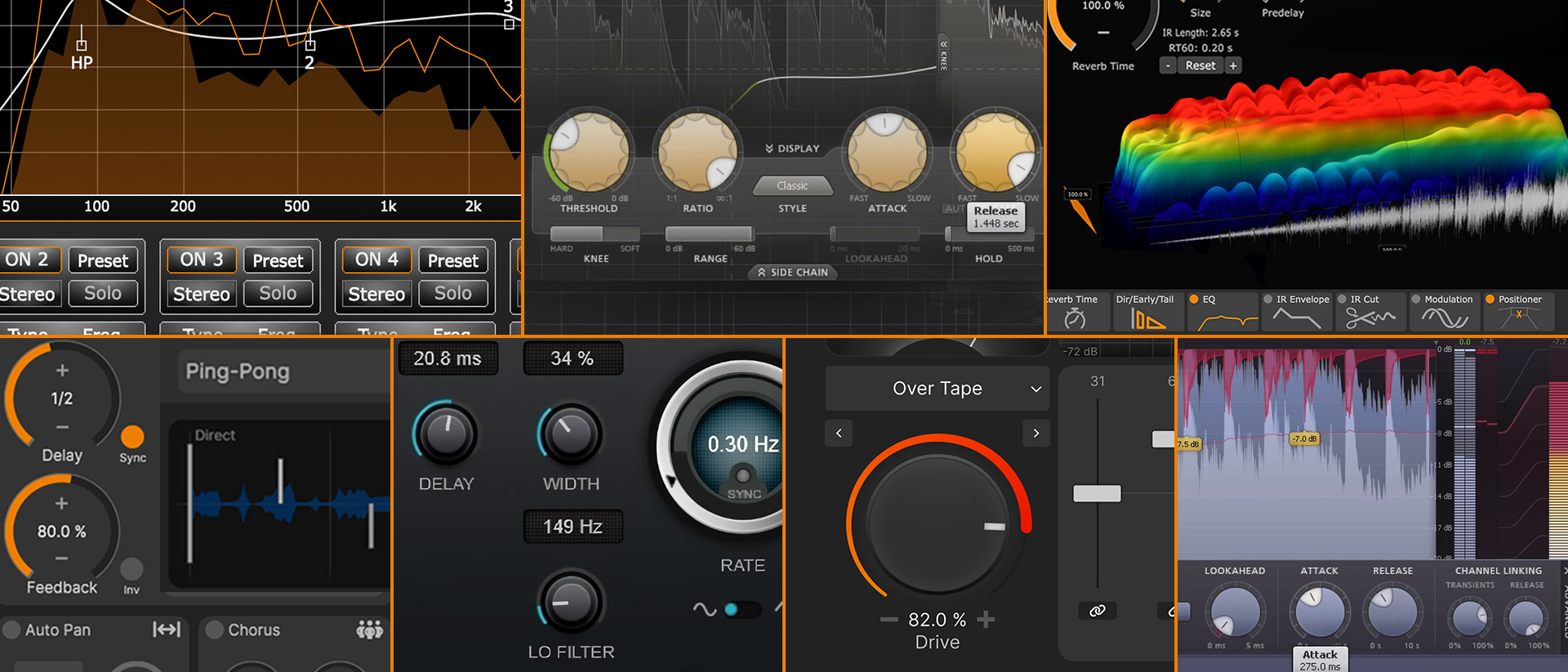
In this post, we’ll walk you through the seven most important audio effects and their applications. Whether you work as a sound engineer in the studio or mix your own tracks as a music producer, these effects are part of the toolkit you should know. While some of them are used as standard in every mix, others are better suited for tonal colouring, spatial design, or creative sound design.
1. Equalizer
The equalizer is a tool for shaping the frequency spectrum. It lets you boost or cut specific frequency ranges – bass, mids, or highs – to shape the sound or remove unwanted resonances.
It uses different filter types:
- Bell filter – boosts or cuts a narrow, bell-shaped frequency range around a specific center frequency. Ideal when you want to target a single frequency or resonance without affecting the rest of the spectrum.
- Shelf filter – evenly boosts or cuts all frequencies above (high shelf) or below (low shelf) a set frequency, that (like an actual shelf) stays at one level from a certain point onward. It’s suited for shaping the entire high or low end broadly, rather than just a single point.
- High cut or low cut – to cut off the upper or lower end of the frequency spectrum entirely.
The low cut is also a popular choice for effect automation in intros or bridges.
2. Compressor
A compressor reduces the dynamic range of an audio signal. It makes loud passages quieter, so the overall signal sounds more even and its average loudness can be increased.
Peaks that exceed a certain threshold are reduced according to a set compression ratio. Two other important parameters are the timing controls, attack and release: attack determines how quickly the compressor reduces the signal, while release determines how long it takes to return to its normal state.
You use a compressor, for example, to make a signal punchier or more consistently present in the mix by compressing it.
3. Reverb
Reverb simulates the acoustic properties of a room. It adds artificial reflections to the signal to create depth, width, and spatial placement in the mix.
The pre-delay parameter sets the time before the effect kicks in. The reverb time (decay) and the room size determine the character of the reverb.
4. Delay
A delay creates time-shifted copies of the input signal – in other words, echoes. You use it for rhythmic effects or to enhance spatial perception. The delay time can be set to a fixed value or synced to the tempo. Another important parameter is feedback, which affects how often the signal is repeated.
There are different types of delay: digital delays are great for creating interesting rhythmic patterns, while types like a tape delay with its retro charm are used for colouring and atmosphere.
5. Chorus
Chorus copies the signal and delays the copy very slightly while subtly modulating its pitch. This creates the impression of several voices or instruments playing at the same time.
You use chorus to create width and movement – for example on guitar, vocals, or even bass.
6. Saturation
Saturation adds harmonic distortion to the signal. It emulates the behaviour of analog gear such as tubes, transistors, or tape machines, giving the sound more warmth, density, and presence.
It works very well on vocals and drums, but also in creative sound design.
7. Mastering limiter
A limiter is a specialized dynamics processor that limits peaks in the final mix. It typically works with very high ratios and short attack times to prevent the signal from exceeding a set output level – the ceiling.
The goal is to maximize overall loudness while preventing digital clipping.
Conclusion
These seven effects – equalizer, compressor, reverb, delay, chorus, saturation, and mastering limiter – form the basic toolkit for virtually any mix. Some of them, like EQ and compression, are part of the standard repertoire, while others, like chorus or saturation, are often used for colouring and creative sound design. Once you understand what each effect is for and which parameters control it, you have the foundation to shape your own sound purposefully.
You want to learn all about audio engineering and music production?
The AUDIO DIPLOMA online course from HOFA-College will give you the complete knowledge and practical experience for excellent sound.

